|
Welcome. In Today's Transport Leader: |
|
|
FREE Policy Infographic
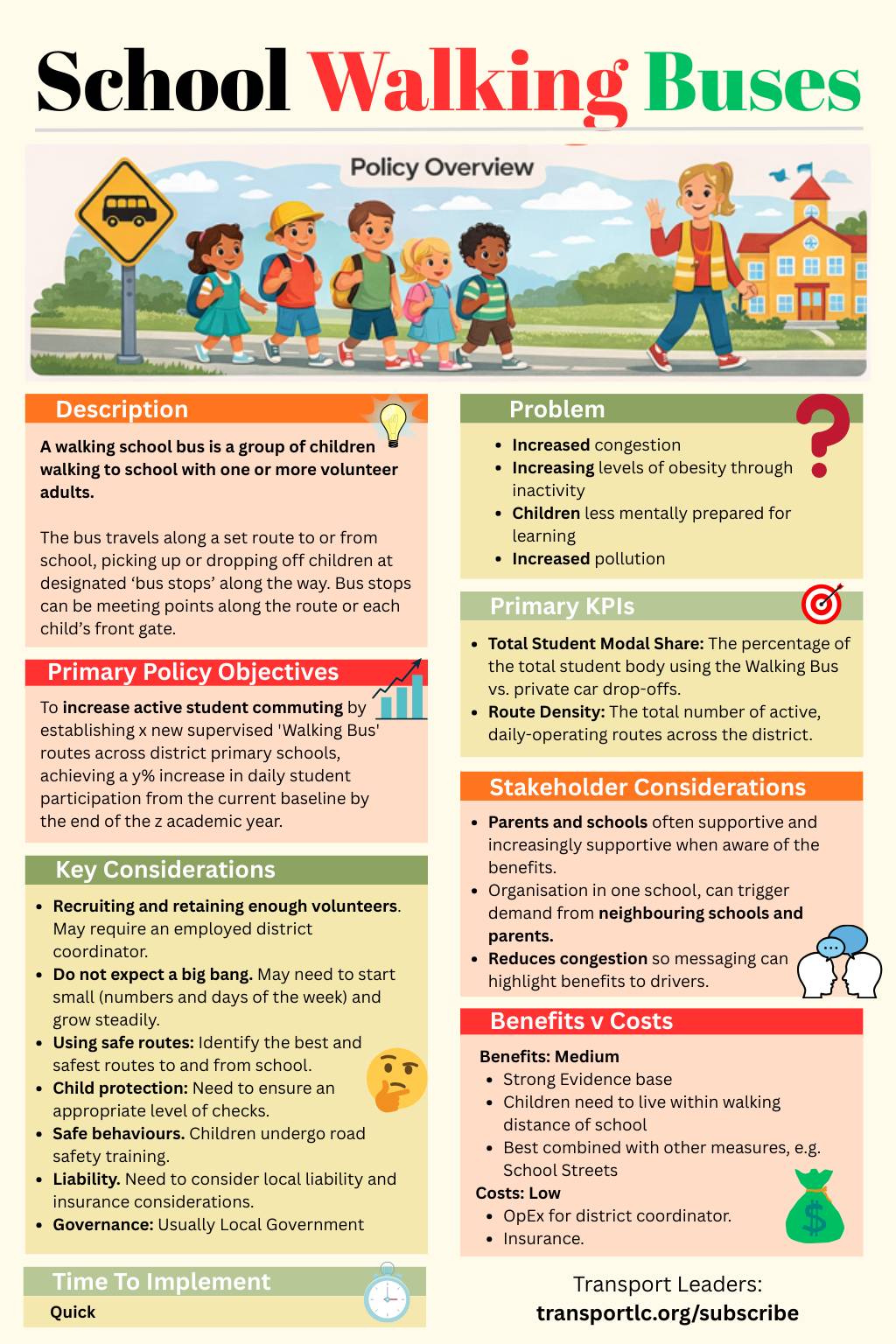
I have begun creating policy-overview infographics. The first one is on School Walking Buses.
It is free to download at the link below. Please help improve our transport systems by liking and reposting this LinkedIn post or sending the link to someone you think will be interested.
|
|
|
Sponsorship Opportunities |
|
- Are you interested in reaching over 3000 transport leaders?
- Please email me: russell@transportlc.org
|
|
|
|
Strategic Planning
Can You Nudge Your Way Out of Car Dependency?
In this newsletter and my blogs, I have often suggested that the evidence shows that we will not get mode shift away from cars through incentives alone; we also need to make driving less appealing. This review of the research provided some further interesting insights.
Key Takeaways
- Cars, as the dominant mode in many cities, are at the centre of heated debates: some value them for their convenience, speed, and flexibility, while others see them as a major cause of congestion and emissions.
- This has led researchers to ask whether soft measures, such as nudging and attitudinal interventions, can reduce car use/ownership, or whether push policies such as congestion charging are needed.
- While objective factors such as infrastructure and costs play a significant role, subjective factors, particularly (un)favourable attitudes towards cars, have gained increasing attention as potential drivers of car use or as behaviour/intention.
- It has been argued that understanding the attitude-behaviour relationship is essential for developing effective policies that not only respond to existing levels of car use or ownership but also guide more sustainable travel choices.
- This conceptual review challenges the long-standing assumption that attitudes strongly dictate behaviour.
- Longitudinal evidence suggests that behaviours, such as car use, have a stronger influence on car attitudes than the other way around.
- Policies that rely solely on changing attitudes, often referred to as “soft” or “pull” measures, such as awareness campaigns or incentives to promote sustainable travel, may be insufficient to drive meaningful shifts in behaviour.
- Interventions should prioritise direct behavioural changes rather than expecting attitude shifts to lead to action.
- Policymakers may need to implement stronger “push” measures, such as restricting car access/ownership, implementing congestion pricing, or reducing parking availability.
- These more radical policies can directly change the habitual behaviours, which in turn may gradually reshape attitudes away from car dependency.
Comment
This research further confirms that soft measures to get people to change their travel behaviour are not very effective. The challenge, of course, is making "push" measures politically palatable.
What Next?
Do you have any strategies for implementing "push" measures to improve your transport mode shares in favour of public and active transport?
|
Rural Transport
Can Demand Responsive Transport Work in Rural Areas? New UK Data Offers Insights
In 2020, the UK's Department for Transport (DfT) invited English Local Authorities (LAs) outside London to bid for funding to trial demand responsive transport (DRT) services in rural and suburban areas. In March 2021, the Rural Mobility Fund (RMF) awarded one-off funding to 15 different LAs to implement and run DRT pilot schemes for between two and four years. They have now published an evaluation of the scheme.
Key Takeaways
-
The primary objectives of the RMF were:
- To improve understanding of whether DRT can fill a gap in current service provision, or work with existing services to create an improved public transport package.
- To better understand the specific barriers unique to DRT and any potential solutions that may establish it as a viable and sustainable alternative.
- The report includes results for 18 schemes operational by the start of 2024. Two schemes served towns and their surrounding villages; three urban edge and rural areas; seven a mix of urban and rural development; and six largely rural areas.
- Passenger journeys per vehicle hour increased slightly over time, and by the last six-month monitoring period, the average was just over two across schemes, with a range from 0.9 to 3.9.
- In most cases where comparisons were possible, total bus passenger journeys increased more in RMF pilot scheme areas than in non-pilot areas, suggesting that introducing DRT can facilitate additional bus usage.
- The most popular destination type has been rail/bus stations, highlighting that DRT is likely to meet the expectation of connecting people to the wider public transport network.
- Most journeys (87%) were booked with mobile apps. Phone bookings to a call centre constituted 11% of all bookings. The average advance booking time for DRT services was 2.7 days.
- In total, £1,654,530 revenue was reported for 823,490 passenger journeys, representing an average of £2.01 revenue per passenger journey.
- The cost of the fund was £19.4m. Based on total passenger journeys, this gives a cost of £23.56 per journey, a subsidy of £21.55 (91%+).
- Bringing the journey subsidy down to acceptable levels remained a major challenge.
- There were clear calls from LAs for greater consideration of social value in the economic assessment of DRT services.
Comment
The current economics of rural DRT services are challenging. As I wrote in my blog this week, I see significant potential for robotaxis in rural areas, though I still think they will require a subsidy.
What Next?
What do you see as the future of transport in regional and rural areas?
|
E-bikes
Lessons from Raleigh's E-Bike Voucher Program
Many e-bike experiments are underway around the world. The City of Raleigh, North Carolina, United States, launched an e-bike voucher program that awarded 150 randomly allocated vouchers to support e-bike adoption. 75 vouchers worth $1,500 went to lower-income applicants and 75 worth $500 went to higher-income applicants. This research report looked at the results.
Key Takeaways
- The study assessed impacts on travel behaviour, vehicle miles travelled (VMT), and transportation insecurity.
- The applicant pool skewed toward lower-income households, residents without cars, and people reporting higher transportation insecurity. 25% of applicants did not own a car, compared to 2.5% citywide.
- Results show voucher recipients were over ten times more likely to acquire an e-bike, with a 174% increase in daily cycling trips compared to controls.
- No statistically significant reductions in car use or VMT were detected.
- Patterns suggest new e-bike trips partly replaced other modes and partly represented induced travel or unlocked suppressed travel.
- Transportation insecurity declined substantially among recipients, with a significantly greater decline over time (possibly as people became more confident on the bikes).
- Participants emphasised e-bikes’ positive effects on independence, affordability, and well-being.
-
Recommendations For Program Improvements:
- Provide clearer upfront guidance about eligible retailers, bike models, and costs
- Expand retailer and bike options, including cargo and adaptive bikes
- Improve communication about approval and redemption timelines
-
Recommendations For Other Cities Considering E-Bike Incentives:
- Pair subsidies with investments in safe cycling infrastructure
- Prioritise outreach to households without cars, older adults, and individuals with disabilities, groups that may benefit more from the program
- Partner with NGOs that can offer training to build rider confidence and skills
- Highlight success stories to build community momentum
Comment
The e-bike vouchers clearly provided significant welfare benefits for people on low incomes. However, the results for VMT are disappointing.
Overall, are e-bike vouchers a good idea? For me, we need to compare them against alternatives. For example, are travel wallets that can be used for any mode, including e-bike purchases, a better way to meet people's transport needs?
What Next?
How could e-bike vouchers fit into a broader strategy supporting transport needs, especially amongst those who do not own a car or would like to give up their car?
|
Quick Adventures in Transport Wonderland
Here is what else I came across this week:
|
Podcast
Are Transport Business Cases Working?
This week on the Transport Leaders podcast, Graham McCabe and I discussed business cases:
- The Evolution Problem: How business cases grew to thousands of pages, adding years and millions to the approval process
- Mode Bias: Why having road agencies evaluate road projects creates inevitable conflicts of interest
- The 30-Second Question: Does saving commuters 30 seconds actually create value, or are we fooling ourselves?
- Political Reality: How ministerial announcements happen before business cases are complete, rendering them almost useless for decision-making
- Measurement Mania: Are we adding carbon assessments and endless studies that politicians already ignore?
- The AI Opportunity: Could artificial intelligence help identify flaws, incorporate the latest research, and speed up the process?
You can watch it here or listen here.
|
Tools
School Streets
This week, I came across this School Streets toolkit.
|
|
|
|
Last Stop
This week’s newsletter has reached its destination.
Before you go: Here's how I can help
Working through a transport policy challenge?
I offer consulting, coaching, and training services to help you navigate complex decisions, build stakeholder support, and implement effective solutions.
Whether you need strategic guidance on a specific policy, want to develop your team's capabilities, or are looking for expert analysis, I'd be glad to discuss how I can support your work.
Get in touch at russell@transportlc.org
|
| What did you think of this newsletter? |
|
|
|
|
|
|
|